

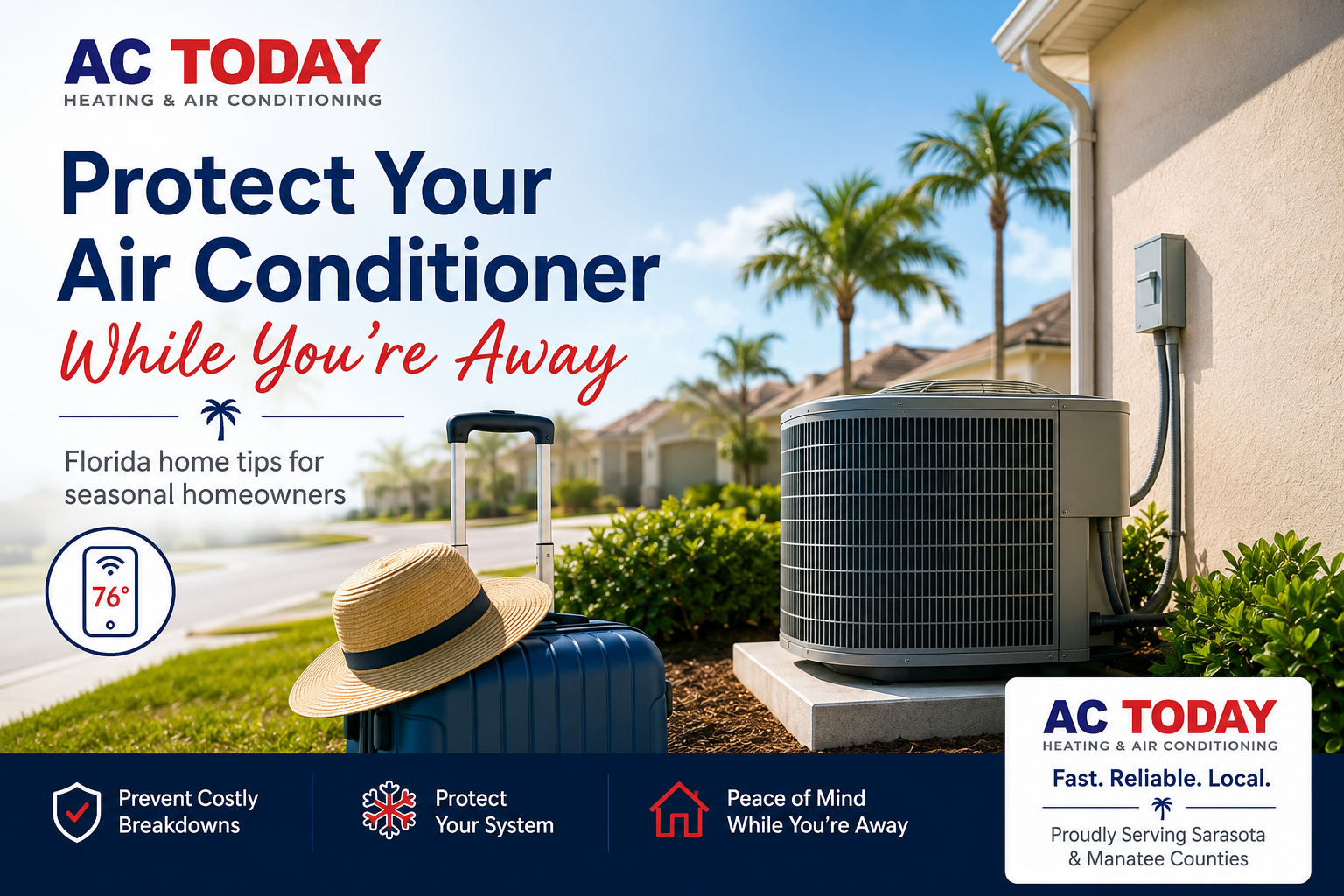
2026 Guide for Snowbirds, Seasonal Residents and Vacation-Home Owners
Last updated: July 30, 2026
| THE SHORT ANSWER Before leaving your Florida home for several weeks or months, have the air-conditioning system inspected, replace the filter, confirm that the condensate drain is clear, set the thermostat for humidity control and enable remote temperature and humidity alerts.Do not turn the air conditioner off completely. Florida homes need ongoing cooling and moisture removal even when nobody is living in them.For the most complete protection, combine preventive HVAC maintenance, remote monitoring and recurring visual inspections by a reliable local person or professional home watch service. |
Why Your AC Still Matters When Nobody Is Home
Your air conditioner does more than cool your Florida home. It also removes moisture from the indoor air.
When the system stops operating, temperatures can rise and indoor humidity can increase. Depending on the conditions inside the house, excessive moisture may contribute to condensation, musty odors, mold growth and damage to flooring, cabinets, drywall, furniture and personal belongings.
Seasonal homes face an additional problem: an equipment issue may remain undiscovered for days or weeks. An absent homeowner may receive no warning unless the property has remote sensors or someone physically checks it.
The Eight-Point AC Checklist Before Leaving Florida
1. Schedule preventive AC maintenance
Have a licensed HVAC contractor inspect the system before an extended absence. Maintenance cannot guarantee that the equipment will not fail, but it can identify worn components, restricted airflow, drainage problems and other conditions that could become more serious while you are away.
2. Replace or inspect the air filter
A dirty filter restricts airflow and can cause the system to work harder. Install the correct filter for your equipment and anticipated time away. Higher-efficiency filters are not automatically better for every system.
3. Confirm that the condensate system is draining
Florida air conditioners may remove substantial moisture from indoor air. Ask your HVAC technician to inspect the drain line, drain pan and safety controls before you leave.
4. Do not turn off the air conditioner
Turning the AC off may reduce electricity use, but it also removes an important source of indoor humidity control. Select a reasonable temperature and humidity strategy for the home.
5. Install a smart thermostat or remote sensor
A connected thermostat can notify you when indoor temperature rises, humidity exceeds a threshold, the thermostat loses power or the system runs without reaching its setting.
6. Check the electrical supply
Verify that the thermostat, indoor equipment and outdoor unit are operating normally before leaving. Do not switch off breakers serving the air-conditioning system.
7. Close doors and windows securely
An open or poorly sealed door or window allows hot, humid outdoor air to enter the home and can make remote readings harder to interpret.
8. Create a written response plan
Identify who will enter the property, who may call an HVAC contractor, where access information is kept and how the homeowner can be reached.
Comparing Ways to Monitor Your AC While Away
| Protection method | Overall protection | What it can do | Important limitation |
|---|---|---|---|
| No monitoring | ★☆☆☆☆ | Keeps costs low | A failure may remain undiscovered |
| Smart thermostat only | ★★★☆☆ | Reports temperature, humidity or connectivity changes | Cannot inspect the home or identify the physical cause |
| Neighbor or friend | ★★★☆☆ | Provides an in-person look when available | Visits may be inconsistent or undocumented |
| HVAC maintenance plan | ★★★★☆ | Helps maintain equipment and provides professional HVAC support | Does not provide regular whole-home inspections |
| Professional home watch visits | ★★★★☆ | Provides recurring visual inspections and documented observations | Does not replace licensed HVAC diagnosis or repair |
| Maintenance, sensors and home watch combined | ★★★★★ | Adds prevention, alerts and physical inspection | Requires coordination among the homeowner and service providers |
The most complete approach is usually layered. Preventive maintenance reduces avoidable mechanical risk, sensors provide early alerts, and physical inspections help determine what is actually happening inside the property.
What a Smart Thermostat Cannot Tell You
A thermostat may show that the house is getting warmer, but it usually cannot tell you why. Possible causes include:
- A power interruption
- A clogged condensate drain
- A failed component
- A thermostat or communications problem
- A refrigerant-related issue
- Restricted airflow
- A damaged outdoor unit
- A door or window left open
- Lost internet connectivity rather than an AC failure
A remote device also cannot reliably determine whether water is collecting near the air handler, condensation is forming around vents or a musty odor has developed. That is why an in-person inspection remains valuable.
Who Can Check the Home When You Are Away?
Some homeowners rely on a nearby relative, neighbor or property manager. Others use a professional home watch provider for scheduled, documented visual inspections.
AC Today’s sister company, Home Watch Today, provides home watch services for vacant and seasonal properties throughout Sarasota and Manatee Counties. Its insured, bonded and accredited team checks homes for visible problems and can notify the homeowner when conditions suggest that an HVAC contractor or another specialist may be needed.
A home watch professional does not replace a licensed HVAC technician. The home watch role is to observe, document and report visible conditions—not diagnose refrigerant, electrical or mechanical problems.
Homeowners may use Home Watch Today, another qualified provider or a reliable local contact. The important point is to establish who will physically enter the house when a remote alert occurs.
Warning Signs That Require Prompt Attention
- Indoor temperature continues rising
- Humidity remains unusually high
- The thermostat goes offline unexpectedly
- The thermostat display becomes blank
- The AC runs continuously without reaching its setting
- A water sensor sends an alert
- Cooling stops after a power interruption
- A local contact notices water, condensation or a musty odor
- The outdoor unit is operating but little air is coming from the vents
- The system repeatedly stops and restarts
Do not repeatedly reset breakers or restart malfunctioning equipment without professional guidance. A recurring shutdown may indicate a condition that needs diagnosis.
AC Today’s Southwest Florida Service Area
AC Today provides AC repair, maintenance and installation services in communities including:
- Sarasota
- Bradenton
- Lakewood Ranch
- Venice
- Palmetto
- Parrish
- University Park
- Longboat Key
- North Port
- Ellenton
- Holmes Beach
- Myakka City
- Englewood
- Port Charlotte
- Surrounding Sarasota and Manatee County communities
AC Today is locally owned and operated, fully licensed and insured under Florida contractor license CAC1817009, and available for HVAC service 24 hours a day.
Helpful AC Today Resources
- Air-Conditioning Maintenance in Sarasota
- Air-Conditioning Repair
- AC Services in Sarasota
- Best Central Air Conditioner Brands: 2026 Guide
- Best AC Companies in Sarasota: 2026 Homeowner Guide
- Best HVAC Companies in Sarasota and Manatee Counties
- AC Today Service Areas
- Schedule HVAC Service
Frequently Asked Questions
There is no single correct temperature for every home. The setting should account for humidity, equipment design, property characteristics, the season and insurance requirements.
For many residential systems, “auto” is generally preferred because the fan stops when the cooling cycle ends. System designs vary, so confirm the appropriate setting with your HVAC contractor.
Turning the AC off removes active cooling and dehumidification. In Florida, the potential moisture risk can outweigh the energy savings.
It is an important safeguard but not a complete solution. A thermostat cannot inspect for water, odors, condensation, storm damage or other visible property conditions.
The appropriate schedule depends on the property, season, insurance policy and homeowner preferences.
Not unless that person or company also holds the required HVAC license and is engaged to perform HVAC work.
A brief outage may not create a problem if the system restarts normally. A longer outage, surge, tripped breaker or equipment fault may prevent cooling from resuming.
Schedule it early enough to address any problems discovered during the visit.
Final Recommendation
Before leaving your Sarasota or Manatee County home for an extended period, use a layered protection plan:
- Schedule professional AC maintenance.
- Replace the filter and inspect the condensate system.
- Leave the air conditioner operating at an appropriate setting.
- Enable remote temperature, humidity and water alerts.
- Test all notifications before departure.
- Designate someone who can physically inspect the property.
- Leave written access and repair-authorization instructions.
- Respond promptly to abnormal readings or visible moisture.
The goal is to reduce preventable problems and shorten the time between a failure and its discovery. For seasonal Florida homeowners, that combination can make the difference between a routine HVAC repair and extensive heat, humidity or water-related damage.
For AC maintenance, repair or seasonal system preparation in Sarasota and Manatee Counties, call AC Today at 941-306-3187 or schedule service online.
AC Stopped Working? Same-Day AC Repair Guide for Southwest Florida » « Best Central Air Conditioner Brands: 2026 Guide